
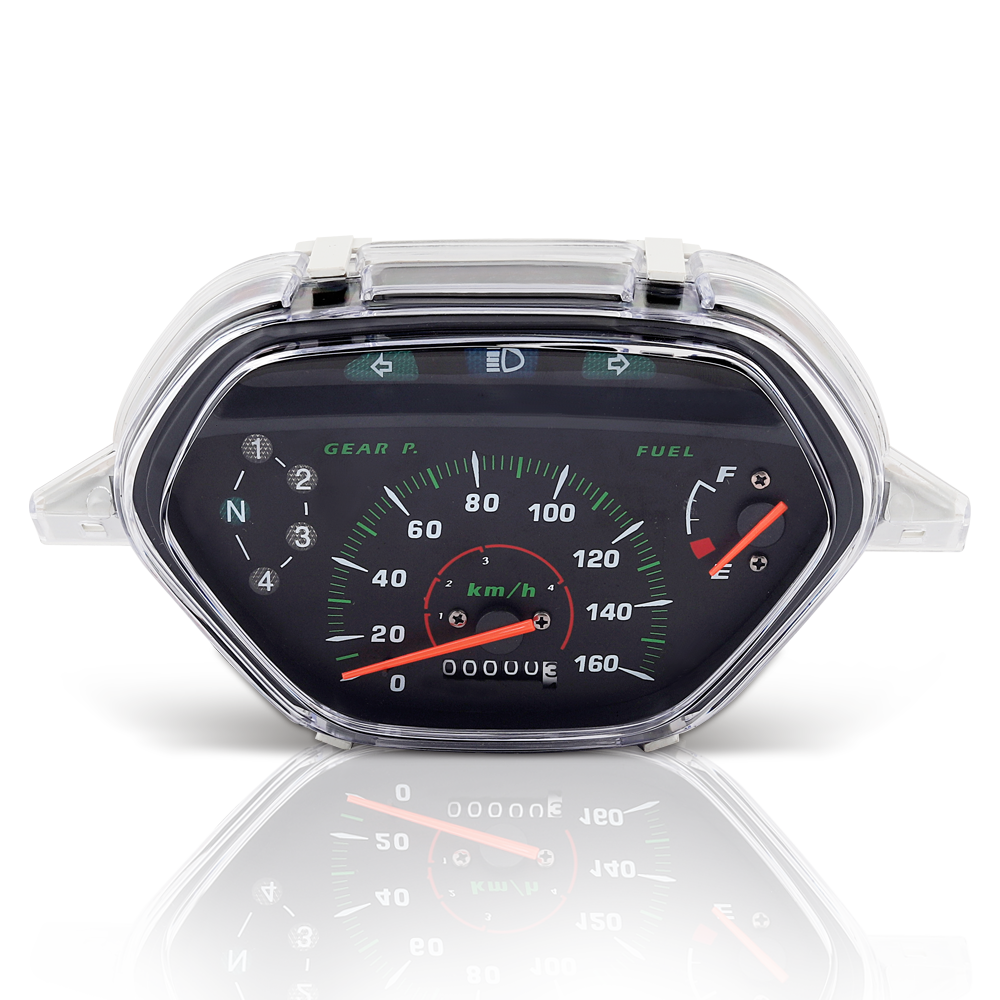
We manufacture a wide range of speedometers and instrument panels. We believe in in-house manufacturing of critical component parts.
Strengths
- Easy-to-read hands and clocks
- Digital display technology
- Elegant design
- Anti-glare screen
- Long service life
- Raincoats
- Dustproof
Related products
- Raw Material
- Manufacturing
- Evidence
Our instrument panels are manufactured using high-quality, virgin polypropylene raw material. PP is
a very suitable plastic for injection molding. Our high-quality raw materials provide
the product with high rigidity and stability. Below is a comparison of our instrument panel with another Chinese brand,
demonstrating our superior raw material.
| Parameter | Details | Elpra | Chinese Product | Advantages of Elpra |
|---|---|---|---|---|
| Raw material | Outer Casing Raw Material P |
New PP | Recycled PP (80/20) | 1) Excellent impact resistance 2) Fresh PP is easy to mold and flows very well due to its low melt viscosity, therefore reducing mold defects such as air pockets and blistering 3) Strong adhesion to powder coating. |
| Acrylics | PC | Glass | 1) Lightweight material 2) Improved transparency |
The following shows a comparison of small component parts with other Chinese brands:
| Parameter | Details | Elpra | Chinese Product | ElpraAdvantages |
|---|---|---|---|---|
| Purchased Parts (BOP) | Casing | Internal process | BOP | The internal components ensure better process control, therefore guaranteeing better quality and delivery. |
| SPCB | Internal process | BOP | ||
| Acrylic | BOP | BOP | ||
| Magnetic piece | BOP | BOP | ||
| Speedometer sensor | BOP | BOP | ||
| Needle | BOP | BOP | ||
| Wire | BOP | BOP | ||
| – | BOP | BOP |
We have advanced, world-class equipment and a state-of-the-art production environment. We believe in maximum automation and minimal outsourcing. This makes us far superior to other Chinese brands available on the market.
| Parameter | Details | Elpra | Chinese Product | ElpraAdvantage |
|---|---|---|---|---|
| Manufacturing | Injection Molding | In-house automatic machine | Outsource | Better Quality Control and Less Wasteage of PP, Therefore Reduce the Cost Effectiveness |
| Assembly Line | 2 Fully Automatic SMT Production Lines | Manual or Semi-Automatic Production | Fully Automatic SMT Line Ensures Consistent Quality, High Rate of Production and minimizes the QPPM (Quality Parts per Million) QPPM: It is the Number of Defected Parts Produced in 1 Million of Parts Produced |
|
| In-house through Soldering Robots | In-house with Manual Soldering | Robotic Soldering Ensures Zero QPPM, Thus Improving our Quality | ||
| Workshop Environment | Dust Proof Static Free Workshop | No Focus on Dust Control | Prevention of Dust Particles Improves the Robotic Soldering Process |
Each of our instrument panels and speedometers undergoes rigorous testing and inspection to detect any
defects. Only perfectly manufactured parts find their place in the global market.
| Parameter | Details | Elpra | Chinese Product | ElpraAdvantage |
|---|---|---|---|---|
| Testing Standards | Incoming Parts | 100% Inspection & Testing | Random / No Testing | Minimal chances of Inhouse Rejection levels prefinished / finished product |
| In process | Checking at Every Process thru various process specific testing Gauges. | Visual Testing | Control the Standard Parameters at every Process | |
| End | 100% Checking for Function | Random / No Testing | we Ensure Zero Defect in our product | |
| Functional | 1. Vibration Test 2. Water Spray Test 3. Salt fog Test 4. Temperature Test |
No Such Machines | All these Tests Performed Results in Less PPM, hence improving the Quality |
Vibration test:
The speedometer's performance is controlled by high frequency and resonant vibration.
Water splash test:
In this test, the instrument panel is completely sprayed with water to verify its watertightness.
Salt spray test:
High humidity conditions are created in the test chamber to verify if water condenses as mist on the
instrument panel.
Temperature test
Each instrument panel is checked at a high temperature of around 250 degrees Celsius and then at a
low temperature of -80 degrees Celsius to ensure optimal functionality under various conditions.