
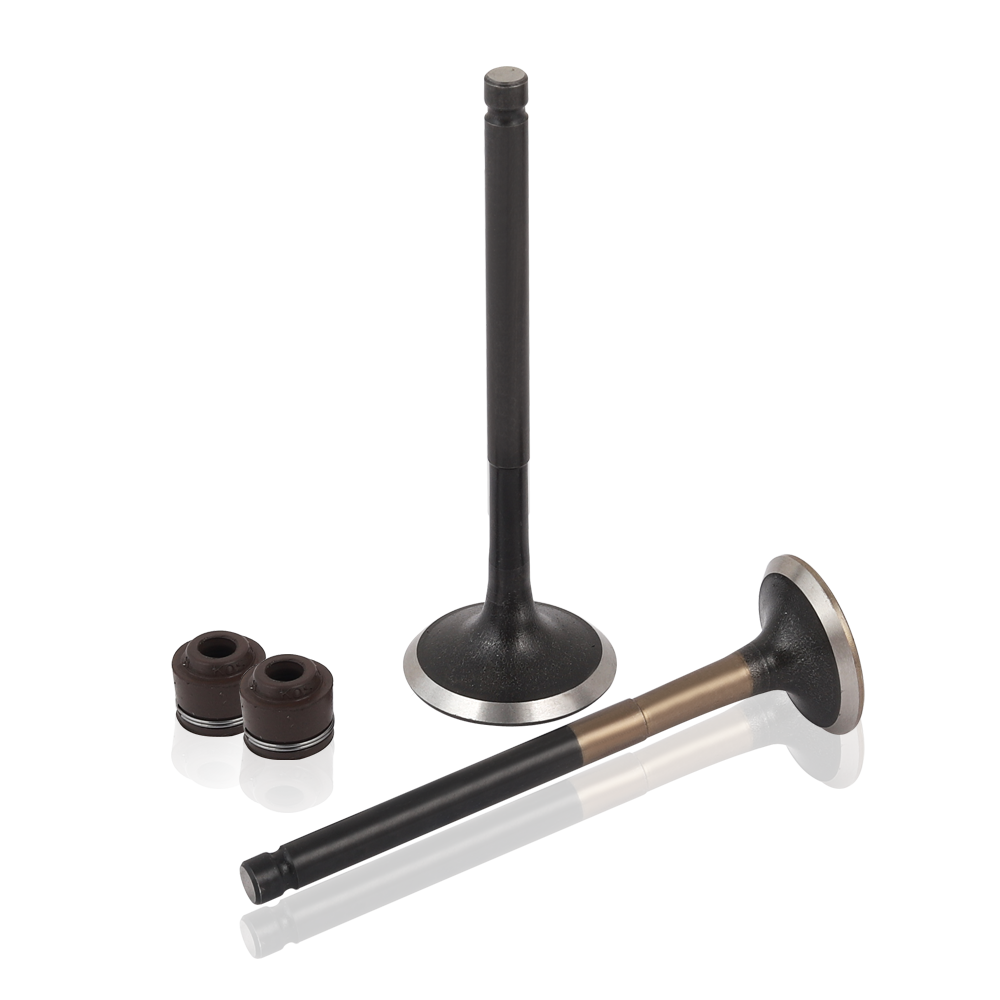
Our lightweight valves offer improved engine performance and fuel efficiency to meet evolving emissions standards. Enhanced fatigue and corrosion resistance are achieved through the increased depth of the nitride valves. All our valves are properly heat-treated, increasing strength and wear resistance in the stem and seating areas. These valves are manufactured to OE specifications with rigorous testing, including 100% inspection of critical features and crack detection.
Strengths:
- High-strength silicon alloy
- Vacuum accumulation welding
- Raw material grade EN52
- 1 hour at 650°C tempering
- Ultrasonic wave fault detection method
Characteristics:
- Vacuum accumulation welding
- Satellite alloy with impact and wear resistant properties
- Exhaust valve made of SCr21Mn9Ni4n grade raw material
- 1 hour at 650°C tempering
- Admission 4Cr10Si2MO
Related products
- Raw Material
- Manufacturing
- Evidence
We use high-strength silicon alloy – EN52 as the basic manufacturing material.
| Parameter | Details | Elpra | Chinese Product | Advantages of Elpra |
|---|---|---|---|---|
| BOP (Parts Purchased) |
Steel Alloy | BOP | BOP | We use high-strength silicon alloy |
| Raw material | Body | High-strength silicon alloy – EN52 | Substandard EN52 | Our product withstands extreme temperatures, pressures, and the impact of a blow; therefore, it is imperative to manufacture each unit with the highest quality. |
Designed with the latest technology, our valves are manufactured using premium materials. Key features of our products include high strength, durability, and effective performance. We also guarantee on-time delivery and offer customized services tailored to the specific needs of our valued customers.
Manufactured using:
- The latest technology
- Special quality casting (valve guide) and steel material (valves)
- Machined, hardened and finished with precision using state-of-the-art machines and instruments.
| Parameter | Details | Elpra | Chinese Product | Advantages of Elpra |
|---|---|---|---|---|
| Manufacturing | Machining | CNC machining center | Semi-automated or manual machines | By using fully automated CNC machines, we offer minimal product tolerance with negligible rejection at the final stage. |
| Design center, tool room and R&D facilities |
Interior design center, tool room and R&D center | Not available from regular Chinese factories | We have exceptional expertise in developing custom formulations for steel products. For molded products, we have an in-house tool room with integrated mold design and manufacturing facilities, enabling fast turnaround times for our customers. | |
| Vacuum Welding | We use vacuum welding which is a solid-state welding process where there is no melting/heating at the interface of the two parts. | They employ the usual fusion welding processes, which means that the liquid or molten phase can lead to chemical diffusion. | Our lightweight valves offer strength with improved engine performance, increased fuel efficiency, and compliance with evolving emission standards. | |
| Tempered | 1 hour at 650°C tempering | Without tempering | Tempering reduces the material's stiffness and increases its strength. Through tempering, we maintain the material's properties (hardness/toughness ratio) for a specific application. | |
| Molding | Automated molding process | Manual molding process | Automatic molding results in relatively low wear under heavy-duty conditions and at higher friction levels. | |
| Heat treatment | Internal heat treatment process | Outsourced in most factories | Grain alignment to provide better raw material strength and reduce internal stress |
We offer two types of valves. The valve that allows the fuel-air mixture into the cylinder is the intake valve. The one through which the exhaust gases escape is the exhaust valve. They are designed to open and close at precise times, allowing the engine to operate efficiently at all speeds. The valve design ensures compliance with thermal and mechanical resistance requirements, as well as wear and durability targets. Surface treatments, coatings, and finishes further enhance durability. Along with the finish, the use of special materials on the valve tip, stem, and seats is also part of the final manufacturing process.
Our valves are manufactured under strict quality control standards established by ISO 9001, undergoing rigorous tolerance testing before shipment. Grain flow detection using microtechnology, crack detection, and microstructure testing are mandatory to ensure our products maintain the highest quality. We coat each valve with appropriate anti-corrosion oil and wrap it in anti-rust paper to extend its service life. We place the utmost emphasis on guaranteeing the quality of our products. Our valves are backed by a quality assurance plan in accordance with TS Certification.
| Parameter | Details | Elpra | Chinese Product | Advantages of Elpra |
|---|---|---|---|---|
| Testing standards | Arrival of parts | Inspection and testing of 100% of the parts received |
Random / Without evidence | Committed to delivering the same product quality/ specifications in every batch |
| In progress |
The internal installation includes : 1. Material |
1. Visual tests 2. On-demand tests from external agents |
1. Standard parameters controlled in each process. 2. Three-axis coordinate measuring machine. 3. Maintains a tolerance range of 0.002 mm to 0.003 mm. 4. Our tests allow for better detection of internal defects, enabling us to produce only perfect parts. The leak test determines the level of uncontrolled airflow through gaps or cracks in the metal body. |
|
| Final inspection | Assembly verification with pneumatic gauge, hydraulic/ electronic universal testing machines |
Manual inspection | It guarantees safe operation and adequate durability. We have an electronic and hydraulic universal testing machine (UTM) to test the tensile strength and compressive strength of the materials used in manufacturing. |
The valve design ensures compliance with thermal and mechanical resistance requirements, as well as wear and durability targets. Surface treatments, coatings, and surface finishes further enhance durability. Along with the finishing process, the use of cobalt alloy in the valve tip, stem, and seats is also part of the final manufacturing process. The effects of various design parameters are studied through simulation testing. Several solutions are also evaluated based on performance and cost. Therefore, our finishing process allows us to refine the quality of each replacement part.
Dimensional test report
| Model | CG125 | P. NO. | Inspected | |||
|---|---|---|---|---|---|---|
| Article title | Intake valve | P. NO. | 5 | Confirmed | ||
| Article No. | QTY | 5 | Conclusion | |||
| Material | 4Cr10Si2Mo | QTY 5 QTY inspected |
Conclusion | Approved |
Dimensional test reports
| Item | Inspections Item | Qualification | Tool | Result | Conclusion | |||
|---|---|---|---|---|---|---|---|---|
| 1 | 2 | 3 | ||||||
| 1 | Crack detection | no crack | Fluorescent Fault Detector | no crack | no crack | no crack | Approved | |
| 2 | Plate shaft runout tolerance | =0.03 mm | Micrometer caliper | =0.02 mm | =0.01 mm | =0.02 mm | Approved | |
| 3 | metallographic | JB/6720-93 | Metallographic Microscope | Approved | Approved | |||
| 4 | Tungsten chromium alloy surface depth | 1.20 -1.50 mm | Calibers | Approved | Approved | |||
| 5 | Macro organization of metal | JB/6720-93 | Acid wash / Visual | Approved | Approved | |||
| 6 | Roundness of the stem | =0.005 mm | Micrometer Caliper | =0.002 mm | =0.003 mm | =0.004 mm | Approved | |
| 7 | Stem straightness | =0.005 mm | Micrometer caliper | =0.004 mm | =0.002 mm | =0.001 mm | Approved | |
| 8 | diameter deviation | =0.005 mm | Digital Display Micrometer | =0.002 mm | =0.004 mm | =0.004 mm | Approved | |
| 9 | Height of the cone face | 0.7±0.15 | GO-no GO meter | Qualified | Approved | |||
| 10 | Stem Hardness | Surface | = HV0.2 600 | Vickers hardness tester | Qualified | Approved | ||
| Internal | HRC 30-40 | Rockwell hardness tester | 37 | 36 | 35 | Approved | ||
| 11 | Hardness of the top | HRC 50-60 | Rockwell hardness tester | 56 | 54 | 55 | Approved | |
| 12 | Rod diameter | 5,450-5,465 mm | Digital Display Micrometer | 5.454 | 5.457 | 5.461 | Approved | |
| 13 | Plate angle | 90-91 | Goniometer | 90′ | 90′ | 90′ | Approved | |
| 14 | Plate roughness | Ra 0.4 | Roughness sample | 0.4 | 0.4 | 0.4 | Approved | |
| 15 | Circular runout tolerances of the stem axis face to face with the rod end |
=0.03 mm | Micrometer Caliper | 0.01 | 0.01 | 0.01 | Approved | |
| 16 | Final surface roughness | Ra0.4 | Roughness sample | 0.4 | 0.4 | 0.4 | Approved | |
| 17 | Stem roughness | Ra0.4 | Roughness sample | 0.4 | 0.4 | 0.4 | Approved | |
| 18 | Concave diameter clip | 4.65-4.70 | GO-NO-GO Meter | 4.66 | 4.67 | 4.68 | Approved | |
| 19 | Long | 93.3± 0.15 | Calibers | 93.36 | 93.35 | 93.38 | Approved | |
| 20 | The symmetry of the bolt hole axis to the bar axis |
=0.05 mm | Calibers | 0.03 | 0.02 | 0.04 | Approved | |