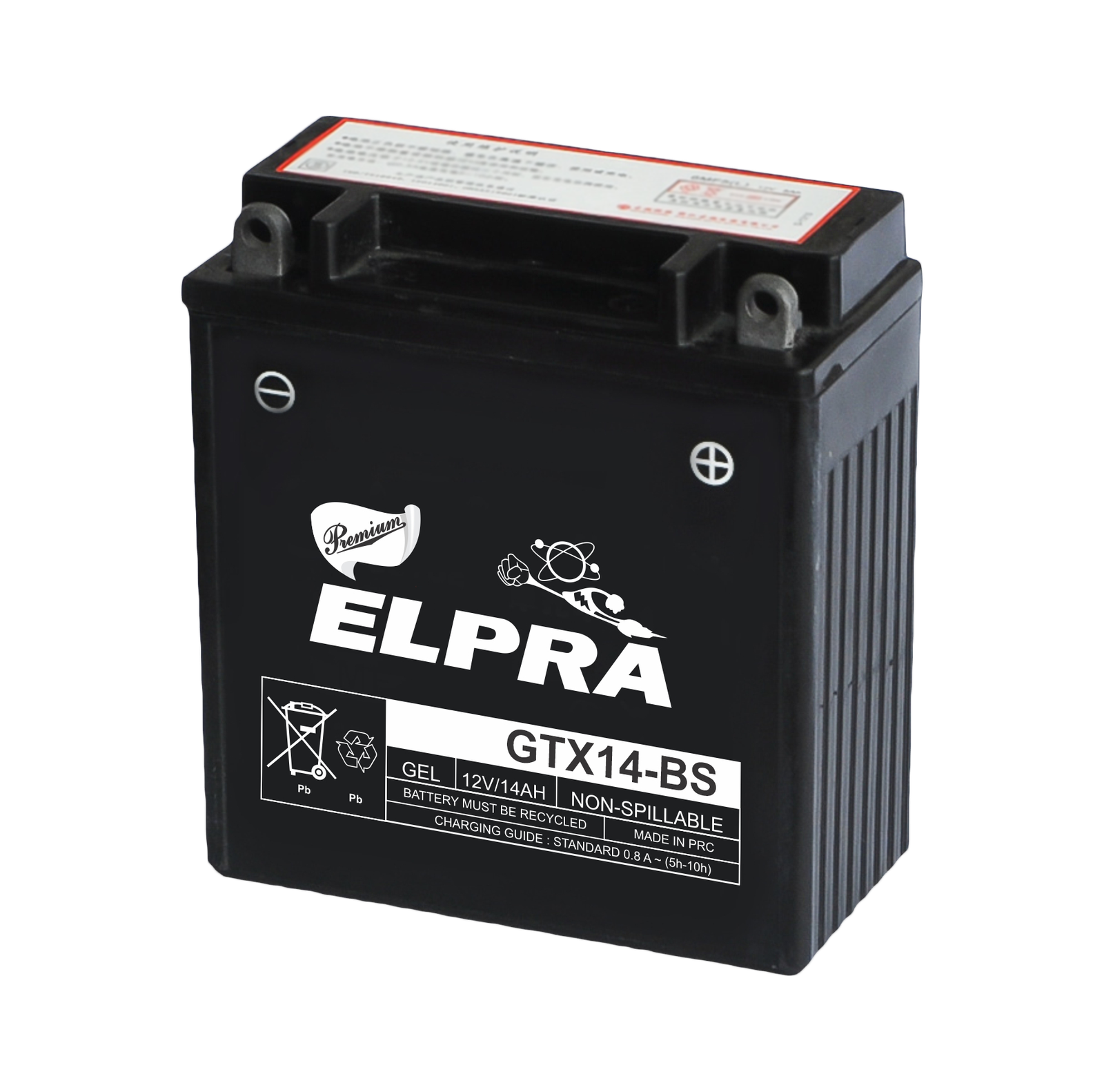
We offer a wide range of sealed maintenance-free (SMF) batteries that require no water. SMF batteries look different from other types of batteries. They are more compact because there is no free electrolyte (it is used in gel form, filling the plate cavities), making them more volume-efficient and taking up less space for their energy storage capacity. Because they are filled with electrolyte only once during activation, there are no filler caps. Instead, a sealing plug permanently covers the filler ports. Additionally, there is no vent tube on this type of battery. The design of this battery allows any released internal gas to recombine within the battery, eliminating the need for a vent tube. The SMF battery can be sealed because the negative plates inside the battery never fully charge and therefore do not produce hydrogen gas. The positive plates create oxygen during the discharge process, but instead of expelling the oxygen through a vent tube, it reacts with the charged active material on the plates to form water. This process continues until the battery is fully charged, at which point the water transforms into acid. This process is called recombinant technology, and this design is what makes our batteries unique. A “factory activated” battery requires no filling before installation. An extensive activation process ensures complete electrolyte absorption, so there is no liquid acid inside the battery. This process allows these batteries to be shipped from the factory ready for installation.
- Evidence
- Product Characteristics
- Battery Charger
- Battery Charging
- Technical Points
- Security
There are two types of battery tests: discharged and charged. A discharged test is performed on a battery without discharging any current. It's the simplest and most commonly used. If you need a more accurate reading, a charged battery test is the answer. It's more precise.
Test downloaded
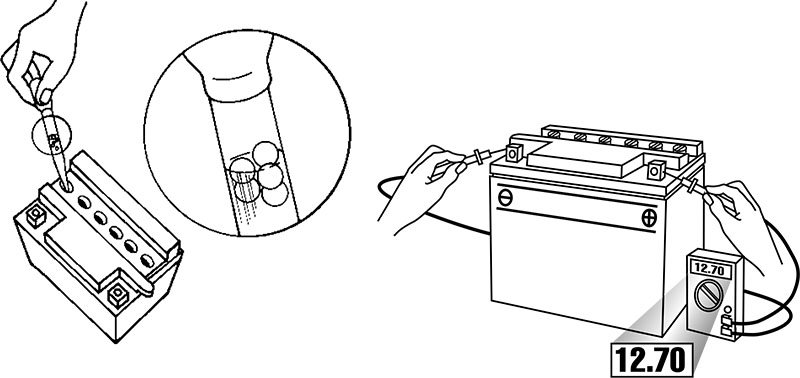
Check the charging status using a hydrometer or voltmeter. With a voltmeter, voltage readings appear instantly to show the charging status. Remember to connect the positive lead to the positive terminal and the negative lead to the negative terminal.
A hydrometer measures the specific gravity of each cell. Specific gravity indicates the degree of charge. Generally, a specific gravity of approximately 1.265 to 1.280 indicates a full charge. A reading of 1.230 to 1.260 indicates that the battery should be charged before testing. The following graph shows the charge level measured by the float hydrometer, the digital voltmeter, and the five-ball hydrometer.
Methods for checking battery condition
| Charging status | Syringe hydrometer | Digital voltmeter | 5-ball hydrometer |
|---|---|---|---|
| 100% loaded with sulfate inhibitor |
1,280 | 12.80v | 5 floating balls |
| 100% Charged | 1.265 | 12.60v | 4 floating balls |
| 75% Loaded | 1.210 | 12.40v | 3 floating balls |
| 50% Loaded | 1,160 | 12.10v | 2 floating balls |
| 25% Loaded | 1.120 | 11.90v | 1 floating ball |
| 0% Loaded | Less than 1,100 | Less than 11.80v | 0 floating balls |
- Completely sealed and maintenance-free
- Lead-calcium technology
- Good load acceptance
- High corrosion resistance
- Higher cold start power
- High vibration resistance
- Spill-proof
- Higher performance/capacity
- Factory charged and ready to use
- Low self-download
- Improved security
- Spill-proof
- Extreme durability
- Absolute security and convenience
- Installation and use without problems
A patented Eastman product.
The Eastman 12V 1.5 Amp Automatic Battery Charger incorporates superior
9-stage charging technology with 10 charging ports. This high-power unit provides fail-safe operation for
fully charging sealed maintenance, conventional, and dry-charge batteries. Controlled by a
microprocessor chip, the charger detects the required charging mode for the battery. The chip monitors the
charging status, and the battery automatically begins charging when the voltage drops to a specified level.
The following are some features of this 12V, 1.5 amp automatic charger:
- Designed to prevent overloading
- AC power LED indicator
- Reverse polarity protection
- Sparkless Operation
- 10 ports to charge multiple batteries at once
- Microprocessor-controlled smart charger
- Automatic cut-off to prevent overloads
- Charging completion indicator
- Faulty battery indicator
- Cables with terminals and connectors included

Technical specifications
- Model – ET 10x2A
- Input – 100- 240VAC 50/60 Hz
- Input cable – 2m / 0.75mm2
- Output – 12VDC 2A per channel
- Maximum charging current: 2 amps-2A
- Maximum voltage – 14.4 + 0.2V
- Output cable – 10 x 0.1/18 AWG
- Charging cable length/AWG-10×1.8/18AWG
Sealed battery charging procedure:
The following are some instructions to follow:
- Connect the cables to the battery terminals before turning on the charger; the red cable goes to the positive (+) terminal and the black cable to the negative (-) terminal.
- Gel or SMF batteries should never be charged above 14.4V as this can damage the battery.
- Initially, reduce the amperage when charging or refer to the instructions provided with the battery to charge at a specific amperage.
- Check the battery's amperage-hour charge 3 times for 15 seconds or use an automatic battery tester to determine its condition, and then check the voltage.
- The voltage must be at least 12.4V in a 12V battery
- The battery is then ready to be installed.
- If the voltage reading is below 12.4V or the battery fails the automatic test, repeat the charge and test cycle.
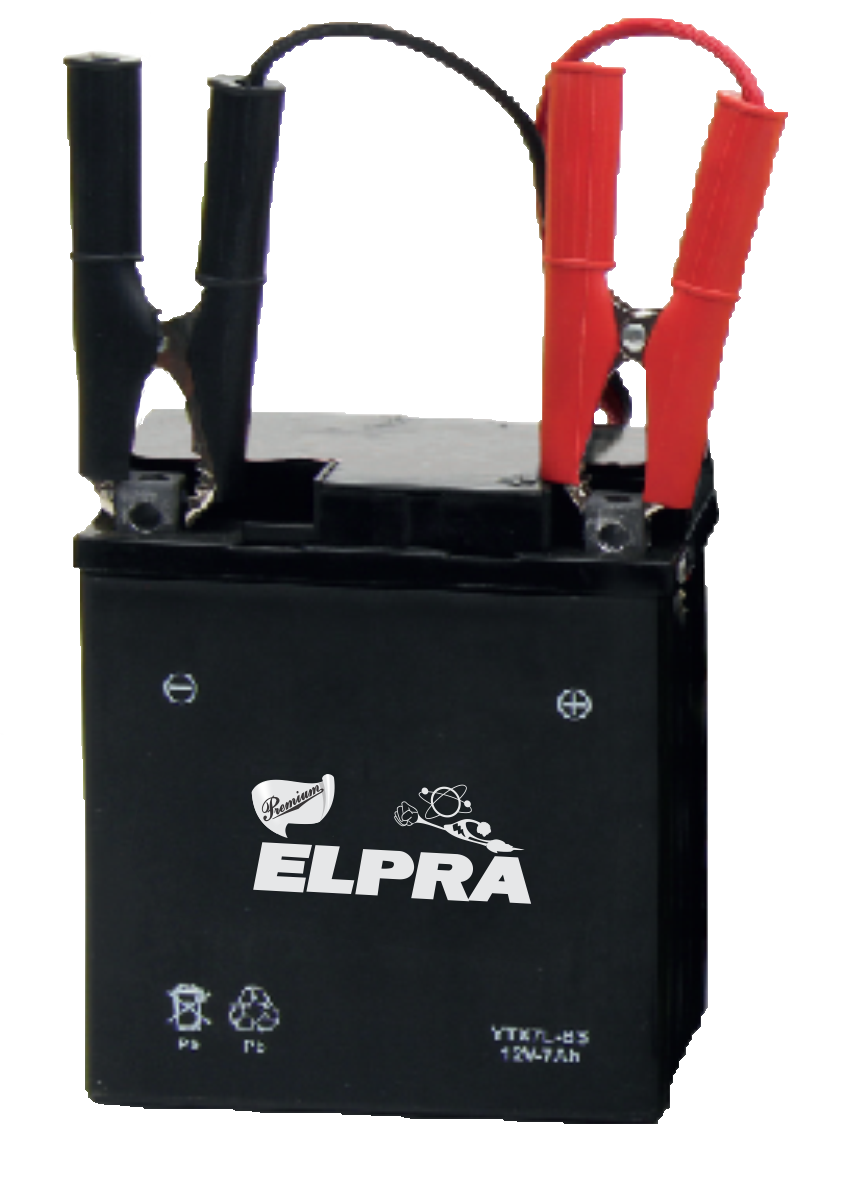
Dry charging procedure / conventional battery charging :
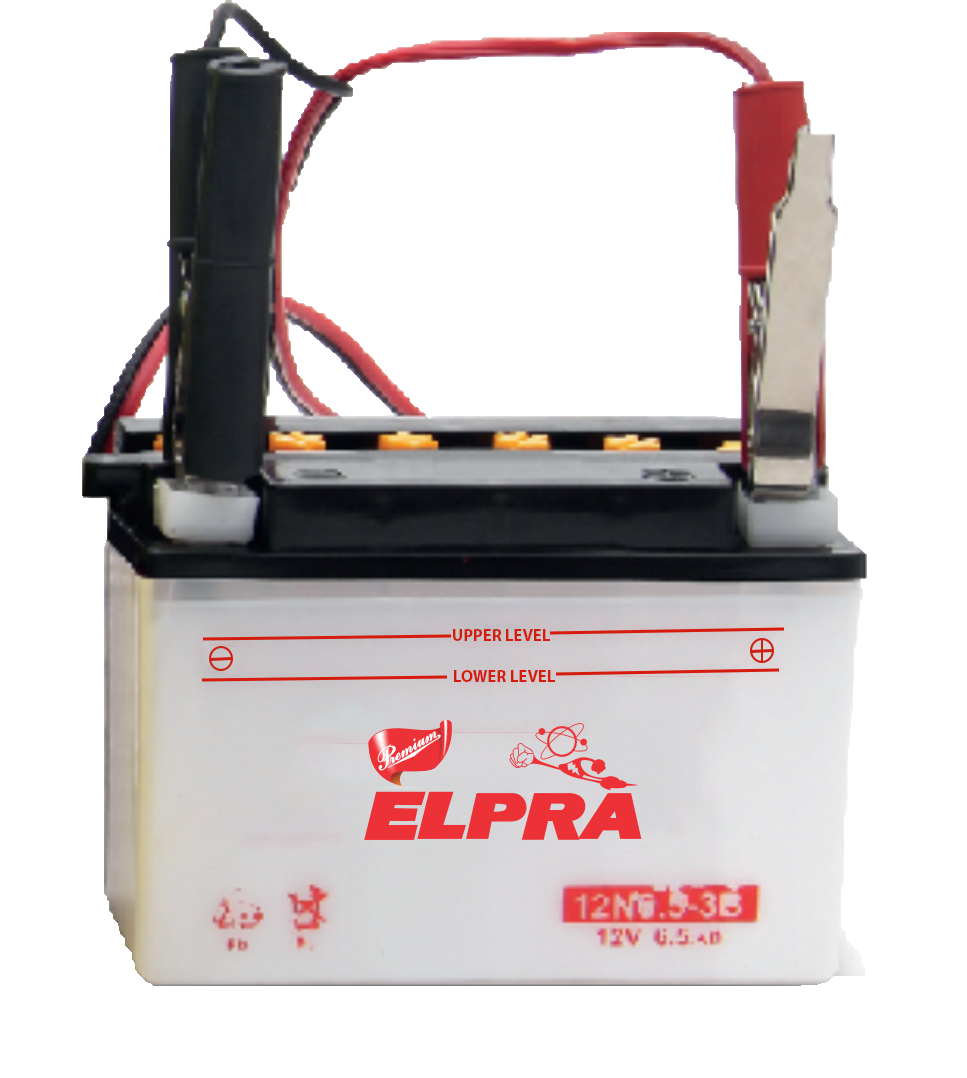
- Place it on a level surface
- Remove the yellow filler caps, placing them securely to one side
- Remove the vent sealing cap; never replace this after the battery has been filled with electrolyte, as it may cause it to rupture.
- Fill each cell with electrolyte to the fill level indicated on the battery box (always wear safety glasses and gloves when working with electrolytes)
- The electrolyte must have a specific gravity of 1.265 and be between 62 – 86 °F
- Leave the battery for a minimum of 30 minutes and gently tap the casing from time to time to remove any bubbles trapped between the plates.
- If after 30 minutes the electrolyte level has dropped, fill it to the upper fill level as indicated on the battery box.
- Loosely insert the filler caps and begin charging the battery at 1/10 of its rated capacity for 3-5 hours. Charging at a faster rate could damage the battery.
- Do not connect or disconnect the battery while the charger is switched on, as this may cause sparks that could ignite the hydrogen gas emitted by the cells during charging.
- Monitor the electrolyte level during charging and top up to the fill line as needed
- When charging is complete, turn off the charger and disconnect it from the battery.
- Push or screw in the yellow filler caps. Be careful not to overtighten them.
- Clean up any spilled electrolyte with water and baking soda solution.
- Allow the battery to rest for at least 30 minutes
- Check the battery's amperage-hour charge 3 times for 15 seconds or use an automatic battery tester to determine its condition and then check the voltage.
- Sealed Construction
The unique construction and sealing technique ensures that no electrolyte leakage occurs from the housing or terminals. - All batteries utilize Ritsuka's unique electrolyte suspension system
, which incorporates electrolyte that is retained within the separator material, preventing free electrolyte from escaping the cells. No gels or other contaminants are added. - Recombination Technology
Ritsuka's battery design incorporates the latest oxygen recombination technology to effectively eliminate the need for refilling during normal use. - Low maintenance operation
Due to the perfectly sealed construction and gas recombination within the cell, the battery is virtually maintenance-free. - Terminals:
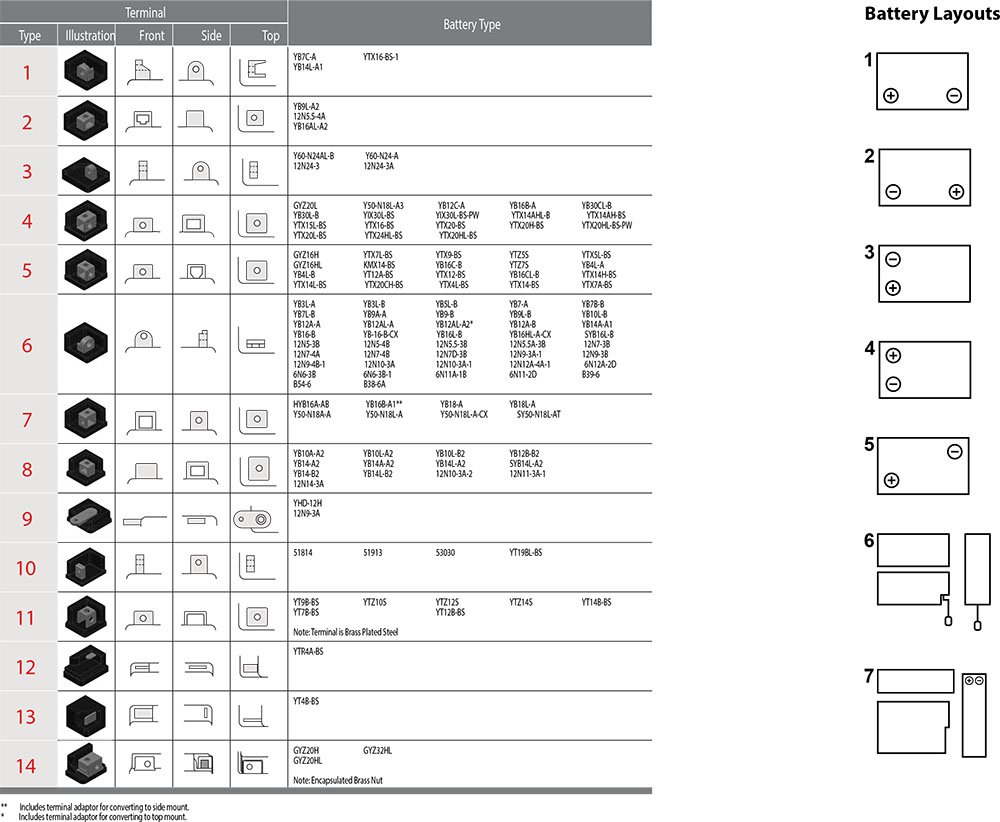
Batteries are manufactured using a range of terminals that vary in size and type. Please refer to the details shown below.
Terminal Configurations
The shapes of the terminals vary from battery to battery. By identifying the correct replacement battery from the list in this book, you ensure you have the correct terminal.
Batteries can be dangerous, so you should always make sure that some simple safety precautions are followed.
Working with batteries presents two risks: potentially explosive gases released during charging
and sulfuric acid, which is highly corrosive.
Here is a list of 8 points that will help keep those risks under control:
- Strictly do not smoke, create sparks, or light flames around batteries. Batteries can produce hydrogen and oxygen; if these ignite, the battery may rupture.
- For conventional batteries, close the vent caps when charging and ventilate the entire charging area. A buildup of hydrogen and oxygen levels in the battery or the room where it is being charged can create a hazard.
- If a battery feels hot to the touch during charging, stop charging and allow it to cool before resuming. Heat damages the plates, and an overheated battery can rupture.
- Do not replace the red sealing cap on the battery once you remove it. Doing so could cause trapped gases inside to explode. Also, make sure the vent tube is not kinked or blocked.
- Connect the charger to the battery correctly: positive to positive, negative to negative. Unplug the charger or turn it off before disconnecting the cable; this reduces the possibility of sparks.
- Always wear eye protection, gloves, and protective clothing.
- Clean up acid spills immediately, using a solution of water and baking soda to neutralize (1 pound of baking soda in 1 gallon of water).
- Make sure the acid container is clearly marked and that the work area is well lit.
Points to remember
- Ventilate the battery charging area.
- The cargo emits gases: smoking, sparks or flames are not allowed.
- Safety glasses or face shields protect against eye damage.
- Acid that is ingested or gets in the eyes requires immediate antidotes and medical attention.
- All safety considerations are important… review them frequently.
Battery testing devices
How much charge does a battery have? There are two easy and reliable ways to find out:
- A hydrometer, which comes in the form of a float or calibrated float
- A voltmeter (or multimeter, which gives DC voltage readings).
Which one is the best?
If you choose between hydrometers, opt for the calibrated float type. It gives you an accurate specific gravity reading (i.e., the density of the electrolyte compared to water), which is much more precise than float balls. A voltmeter or multimeter can be used where a hydrometer cannot. Most sealed or low-maintenance VRLA batteries should be tested with a voltmeter.
Testing a battery requires a voltmeter that can measure DC voltage. Always remember to connect the voltmeter in parallel with the circuit being tested, observing the correct polarity; otherwise, the pointer will move in the wrong direction. It's a good idea to periodically check your voltmeter against another of known accuracy.